I Replaced 4 Sales Tools With One CRM
I was paying for four separate tools just to manage sales. Here's what happened when I replaced all of them with one conversational CRM.
 Dr. Andreas Fruth
The Morning I Realized I Had a Tool Problem
It was a Tuesday. I had 14 deals in play, and I couldn't tell you the status of a single one without opening four different apps. My email tracker said I'd sent 23 follow-ups that week. My spreadsheet had notes from calls I'd made the week before. My task manager had reminders I'd snoozed twice. And my calendar app was pinging me about a meeting I'd already rescheduled.
I spent 40 minutes that morning just syncing my own brain across four tabs. Not selling. Not building relationships. Just copying data from one place to another so I wouldn't drop the ball.
That was the day I decided something had to change.
Tool #1: The Email Tracker
Knowing that someone opened your email doesn't tell you what to do next. A prospect opened my proposal three times — great, now what? I'd switch to my spreadsheet to check the pipeline, then to my task manager for a reminder, then back to email to draft the message. Four context switches for one action.
With Kit, the context is already there. Deal history, last touchpoint, pipeline stage — all in one place.
What I lost: open-rate vanity metrics. What I gained: 20 minutes back every morning.
Tool #2: The Spreadsheet "CRM"
When you have 5 deals, a Google Sheet works. When you have 50, it becomes a place where information goes to die. I've written about this before — the tipping point sneaks up on you.
Updating 14 columns felt like filing taxes. So I'd let it slide, and then I couldn't trust it anymore. Duplicate data everywhere. No versioning. No timeline. Just a flat grid pretending to be a relationship history.
In Founders Kit, every interaction lives on the deal or the contact. I ask Kit "What's the latest on the Bremer account?" and get the full picture.
The spreadsheet cost me nothing in dollars and roughly 3 hours a week in data entry I mostly skipped anyway.
Tool #3: The Task Manager
Solid for project work, terrible for sales follow-ups. Every task needed a title, a due date, a project, and tags. For "call Marcus back on Thursday," that's absurd. Within a month I had 47 overdue tasks — not because I wasn't doing the work, but because I wasn't going back to check them off.
What I needed was something that understood why a task existed in the context of a deal. Kit creates tasks tied to deals, scheduled for the right date — not buried in a generic to-do list.
A task without context is just noise. Sales tasks need to live where the sales data lives.
Tool #4: The Calendar Reminder App I Forgot I Was Paying For
This one's embarrassing. I was paying $8/month for a calendar reminder tool that sent me SMS nudges before calls. I set it up during a particularly chaotic quarter and then... just kept paying for it. For nine months.
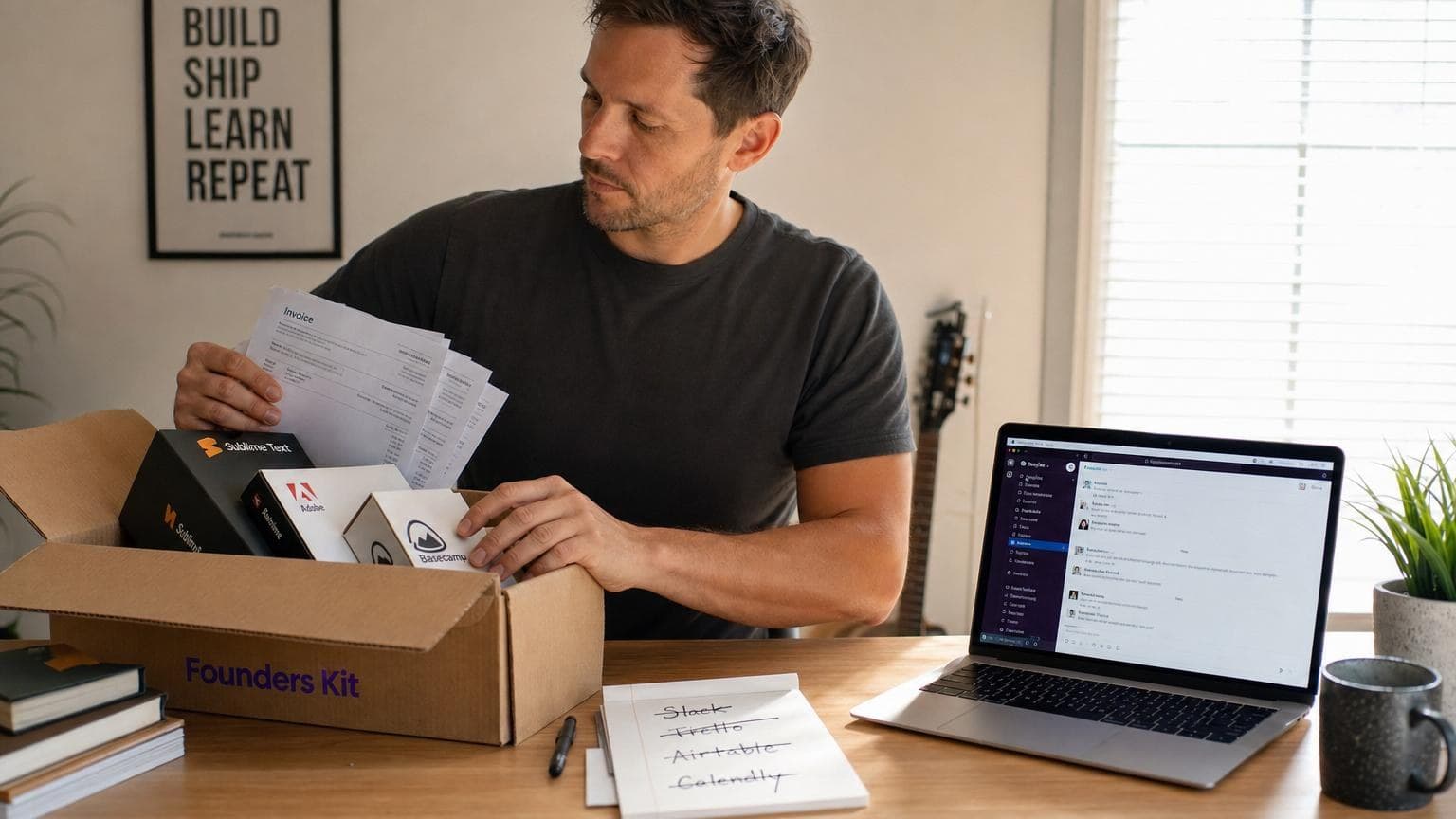
My calendar already had the meetings. My CRM now creates activities and links them to deals. I literally didn't need a third-party app to text me about things I could see in two other places. But that's what happens when you bolt tools together one at a time — you lose track of the overlap.
If you can't list every tool you're paying for right now, that's a sign you have too many.
The Real Cost Isn't Money — It's Attention
Those four tools cost me $67/month combined. Not the problem. The attention tax was. Every context switch costs refocusing time — roughly 13 hours a month I wasn't spending on actual sales work. For a solo founder, that's the difference between closing a deal and losing it.
What I'd Tell a Founder Still Juggling Four Tools
Don't fix this by adding a fifth tool that "integrates" the other four. Ask yourself: am I the integration layer? If you're copying data between apps, you're doing work a system should handle.
I didn't need four tools. I needed one place that understood my deals, my contacts, my tasks, and my conversations. That's what a conversational CRM actually gives you. Not more features. Fewer tools.
If your sales stack has more apps than team members, it's time to consolidate.